


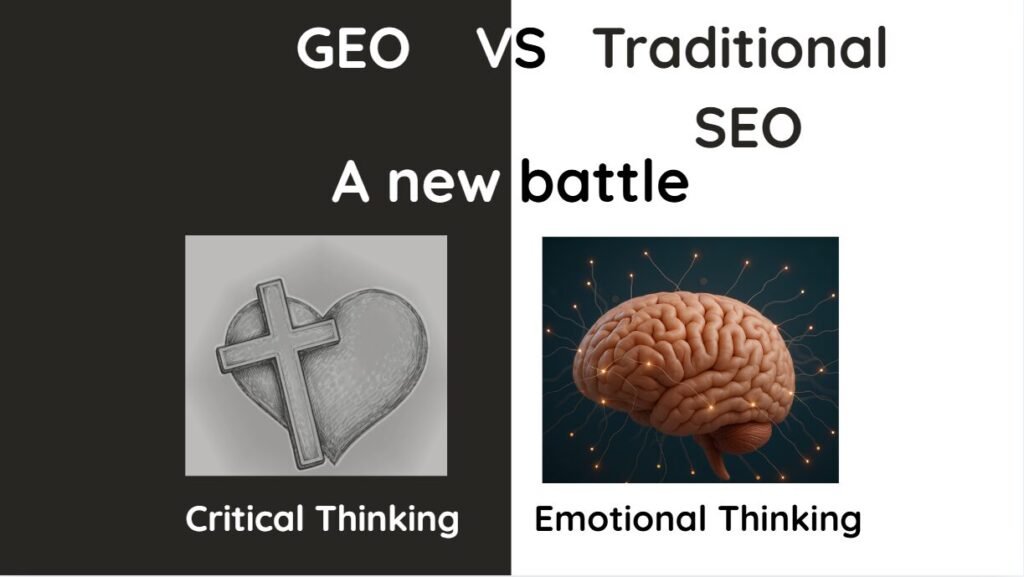
Generative Engine Optimization (GEO) vs Traditional SEO: Navigating the Future of Search
Searching trend has changed in 2026 and this change has happened with a rocket speed. Earlier the focus of marketers, content creators and businesses was on traditional SEO- making websites rank high in search engine results pages (SERPs) and get maximum clicks. But today with the emergence of AI tools like Gemini, ChatGPT, Perplexity etc, the focus has shifted towards Generative Engine Optimization (GEO).
This new trend emphasizes on how content and brands appeal in AI-generated answers rather than just websites ranked on a list of links. To win the race, you must evolve and know about the visibility trends in 2026 to stay competitive.
Traditional SEO: What It Is and Why It Matters
Traditional search engine optimization (SEO) laid the foundation of digital marketing. This strategy helped companies to stay at the top in search engines when audience looks for offerings on Google or Bing similar to theirs. This involves keyword optimization, gaining backlinks from reputed sources, page loading speed and focus on other technical website aspects that are search-engine friendly.
For almost two decades, marketer’s world revolved around keyword rankings, clickthrough rates (CTR) and organic traffic. The only aim of the companies was to rank websites at the top of search engines to capture largest share of clicks.
However the story has got twist now. Zero-click searches have gained popularity now. Many visitors get the information on search engines without clicking on any external link. Around 58% of U.S. Google searches now end without a click.
This implies your website may or may not receive desired traffic despite of its top ranking on search engines. This is because people get the resolution of their queries without even clicking through.
The Rise of Generative Engine Optimization (GEO)
Generative Engine Optimization (GEO) or you may call as AI SEO services is a buzzword in this AI era. Instead of only focusing on ranking, GEO emphasizes more on getting content cited, references or included in AI-generated responses. The working process of today’s AI search systems is entirely different from traditional one. Instead of delivering list of links, these models make use of large language models (LLMs) to answer queries, deliver information from multiple sources and provide accurate and conversational responses. Users can get the answers they are looking for without clicking, scrolling or landing on any page.
For instance, AI-overviews now appear on the top of many queries, and when they do, clickthrough rates experience a sudden drop. As per studies, when AI summaries appear, only 8-15% users visit the websites through traditional search results, as compared to the higher CTR in the absence of summaries.
This transformation has severely impacted digital visibility. If visitors are not clicking on the website, then organic traffic metrics will become less popular. Instead brands are now focusing on the strategies to make their content get read and used in AI systems so that their brand will be referred within that ecosystem.
Key Differences Between GEO and Traditional SEO
Let’s understand the basic difference between these two optimizations.
What They Optimize For
- Traditional SEO revolves around the top website ranking on search engines to improve visibility, hoping to get traffic when visitor clicks on the website.
- GEO strives to put the content in AI-generated answers, knowledge panels or conversational responses, where users may not click on the link.
Content Strategy
- In traditional SEO, content focused more on targeted keywords and search volume- long blogs, header optimization and keyword placement.
- In GEO, content is made AI-digestible; fact based and includes clear answers that AI can easily fetch. This could be rich facts, FAQs and structured data markup.
Platforms They Serve
- Traditional SEO was not limited to search engines like Google and Bing.
- GEO also targets AI platforms like Perplexity, ChatGPT and other answer engines where visibility is not limited to only ranking but to inclusion in responses.
Success Metrics
- Success rate of traditional SEO was measured in terms of ranking positions, CTR and organic traffic.
- Success of GEO depends on citation frequency in AI responses, brand visibility in answer output and snippet inclusion rates.
Why GEO Is Becoming Essential
With an immense growth in AI search usage GEO has become an integral part of marketing strategy. As per studies done in late 2025, ChatGPT has touched 800 million active users count weekly. These figures are shouting loudly for generative AI to gather information online and have increased the demand of generative engine optimisation services.
Also, with the rise in zero-click searches, traditional SEO strategy is falling short. Studies reveal that higher ranking websites are now getting fewer clicks than before. For instance, even top ranking results now experience less CTR with the presence of AI overviews. These results sometimes fall short by 30%, which is a huge drop.
All these figures are now pointing towards GEO strategy. When content is structured to get attention of AI systems, your brand will become more visible inside the answers where users give attention even if they never visit the source website. The aim has now changed from ‘drive traffic’ to ‘earn citations.
Blending the Old with the New
You must notice here that traditional SEO still has its relevance. Websites still get valuable traffic if certain queries related to product or services are not completely answered in the AI results. But in a world where 60-70% searches produce zero clicks, then it’s a high time to complement the traditional SEO with GEO that account for AI search behaviour.
The two strategies must go hand-in-hand. A comprehensive strategy involves:
- Building strong SEO foundations by focusing on backlinks, site health, and keyword research.
- Structuring content for both AI and humans alike.
- Adding semantic clarity and schema markup so that AI tools can fetch the data easily.
- Creating content which is not only comprehensive but also easy for generative systems to refer.
Brands that use both SEO and GEO are winning the race now.
The Future of Search Visibility
Search process is revolutionized now. Instead of competing for first ranking on search engine, brands are now racing to come among the few sources that are cited in AI response. Visibility is now termed in context to something different- not only traffic but authority, recognition and relevance in AI ecosystem.
With the emergence of generative AI, business that will optimize the websites both for traditional and generative engines will remain ahead of the curve. Today, success is not about being found- but about used by the systems that answer users’ questions first.
Hence to remain on your toes in this bottleneck competition you must look for SEO services in Pune that supports both SEO and GEO.